AI-Proof Moats, Ranked: By Market Cap at the Top, by Sale Multiple on Main Street
The fashionable thesis is that AI absorbs moats. Code is cheap, content is free, migration is a weekend project for an agent, and whatever advantage you built out of effort is now a prompt away from being copied. There is something to that. But it is a claim about a specific kind of moat, and if you sort the world's most valuable companies by what actually protects them, most of the money sits behind things an LLM cannot produce: a fab, a bank charter, a payment network, a warehouse footprint.
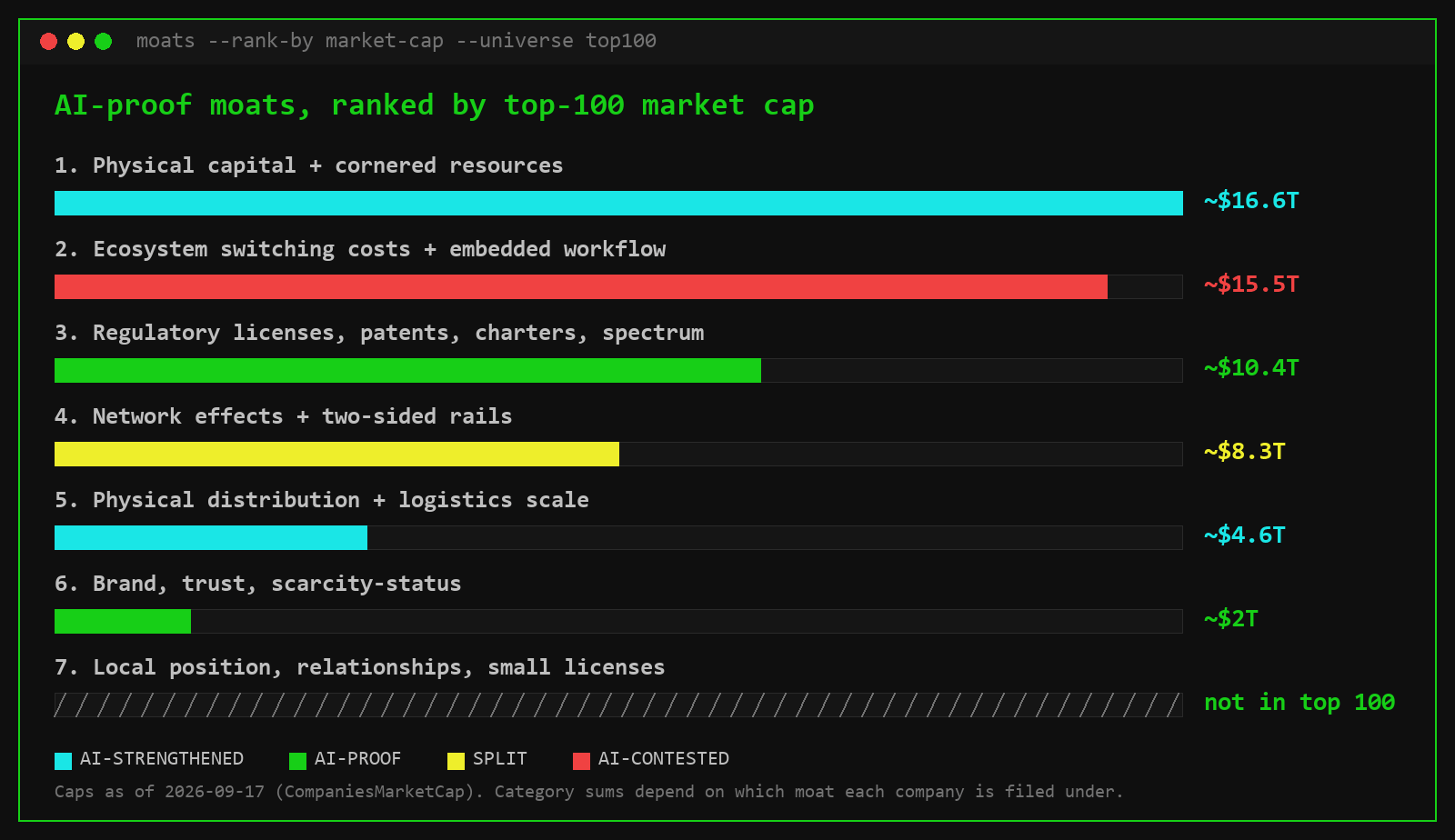
So I ranked them. Twice. First, seven moat types that AI does not erode, ordered by the combined market value of the top-100 public companies whose primary moat is that type. Second, the same question at small-business scale, where market cap does not exist, ordered by what a buyer actually pays for the moat when the business sells. Public-company caps are as of September 17, 2026. The two lists disagree with each other in a way that is more useful than either list alone.
- Ranking moat types by market cap is a category error, and I did it anyway. Every top-100 company stacks three or four moats. Filing Apple or Nvidia under a different type swings a category by roughly $5T. Individual caps are hard data; the category sums depend on judgment.
- The highest-value moats are the ones a small operator cannot touch. Physical capital and cornered resources lead at ~$16.6T, and every AI dollar terminates there.
- The #2 category is the least AI-proof of the durable ones. Ecosystem switching costs (~$15.5T, home of the largest company on earth) are exactly what agents attack by collapsing migration cost.
- At small-business scale the ranking inverts. Real estate and signed contracts outsell licenses and brand. Brand is worth ~$2T at the top and the least at sale on Main Street.
- AI-strengthened beats AI-proof at both scales. The best position is not "AI cannot touch this" but "AI has to buy from this."
How to read the labels
Each row carries an exposure label, and they mean different things:
- AI-proof. AI does not erode the moat. It also does not particularly help it.
- AI-strengthened. The moat gets more valuable as AI grows, because AI needs what it protects or lowers the cost of operating behind it.
- AI-contested. Durable so far, but directly in the path of what agents are good at.
- Split. Part of the category is proof, part is contested, and lumping them together hides the difference.
Claims in the takeaways and method sections carry a confidence tag: [Certain], [Likely], or [Guessing]. The individual market caps are certain. Almost everything built on top of them is not, and I would rather say so than imply precision the method does not have.
Public companies, by market cap
The top-100 aggregate is the sum of market caps for companies whose primary moat is the row's type. That word "primary" is doing the judgment work, which is why the chart at the top of this post should be read as an ordering, not a measurement.
| # | Moat type | Top-100 aggregate | AI exposure | Examples |
|---|---|---|---|---|
| 1 | Physical capital intensity and cornered resources Fabs, memory, energy reserves, launch capacity | ~$16.6T | AI-strengthened | TSMC $2.17T, SpaceX $1.99T, Saudi Aramco $1.65T, Samsung $1.20T, Micron $1.05T, ASML $615B |
| 2 | Ecosystem switching costs and embedded workflow CUDA, Windows and Office, enterprise stacks | ~$15.5T | AI-contested | Nvidia $5.17T, Microsoft $3.64T, Broadcom $1.62T, Oracle $433B, SAP $246B |
| 3 | Regulatory licenses, patents, charters, spectrum Drug approvals, bank charters, defense clearances, airwaves | ~$10.4T | AI-proof | Eli Lilly $1.01T, JPMorgan Chase $927B, Johnson & Johnson $644B, UnitedHealth $337B, RTX $265B, Verizon $207B |
| 4 | Network effects and two-sided rails Payment networks, social graphs, marketplaces, search | ~$8.3T | Split | Alphabet $4.15T, Meta $1.72T, Visa $693B, Mastercard $497B, Tencent $492B |
| 5 | Physical distribution and logistics scale Warehouses, stores, fleets, dealer networks | ~$4.6T | AI-strengthened | Amazon $2.65T, Walmart $855B, Costco $396B, Caterpillar $360B, Home Depot $302B |
| 6 | Brand, trust, and scarcity-status Consumer staples, luxury, heritage spirits | ~$2T (pure-brand) | AI-proof | Coca-Cola $378B, Procter & Gamble $341B, Kweichow Moutai $236B, L'Oréal $233B, LVMH $232B |
| 7 | Local physical position, relationships, and small licenses Liquor licenses, marina access, camera sightlines, HOA boards, field-service trust | Not in top 100 (est. $10T+ in fragmented private-business value) | AI-proof | Every marina, bar, managed-service shop, and field-service operator in the country |
A few of these deserve more than a table cell.
- Tier 1: every AI dollar terminates here. Compute, power, and supply. The capex that funds the models flows to the companies that own the fabs, the memory lines, the energy, and the lithography. This is the clearest case of AI-strengthened: the better AI gets, the more of this it has to buy.
- Tier 2 is the real test case for the "AI absorbs moats" thesis. Switching costs are made of migration effort: rewriting against a different API, retraining staff, porting workflows. Agents collapse exactly that cost. The category holds $15.5T and the largest company on earth, and it is the least AI-proof of the durable moats. If the absorption thesis is right anywhere, it shows up here first.
- Tier 3: AI cannot mint an FDA approval or a bank charter. For pharma it is a tailwind, because AI-assisted discovery yields more patents, not fewer.
- Tier 4 is two categories wearing one label. Payment rails (~$1.4T) are AI-proof. Ad-funded aggregation is contested, and ~$4T of it is Google.
- Tier 5: AI optimizes a network it cannot build. Routing, forecasting, and slotting all get better. The warehouses and trucks still have to exist.
- Tier 6: AI generates content, not trust. The ~$2T is a pure-brand figure. Filing Apple and Berkshire here instead would lift it to ~$8T, which is the category error from the tl;dr in one example.
- Tier 7 is structurally uncapturable at scale: unlimited entry, no concentration, no public exemplar. It is also the only tier open to a venture with under $50k and ten hours a week, which is why it gets its own ranking.
Small businesses, by what a buyer pays
Market cap does not exist below the public markets, so the unit here is the sale multiple: price paid as a multiple of the owner's annual earnings (seller's discretionary earnings, SDE). The median small business sold at about 2.7x in 2026, with a spread from roughly 1.4x for distressed retail to nearly 5x for car washes and HVAC platforms. Rows are ordered by the typical multiple the moat commands.
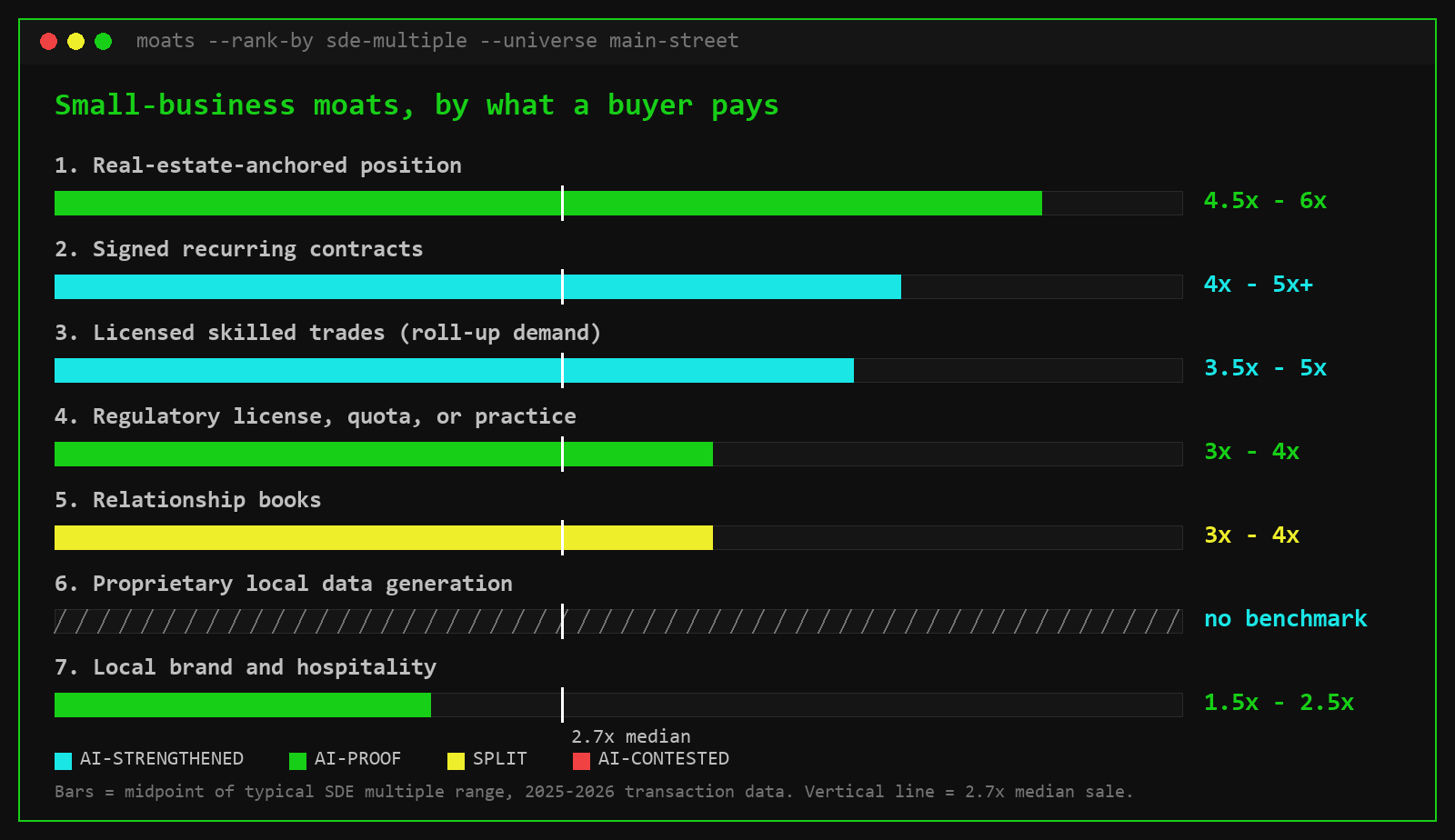 Small-business moats by typical SDE multiple. The tick on each bar is the 2.7x median sale; only local brand and hospitality falls below it.
| # | Moat type | Typical multiple | AI exposure | Examples |
|---|---|---|---|---|
| 1 | Real-estate-anchored position The land, lease, or water frontage is the business | ~4.5x to 6x car washes ~5.8x, self-storage ~4.6x, laundromats ~4.0x SDE | AI-proof | Car washes, self-storage, laundromats, marinas and fuel docks, drive-thru corners, waterfront hospitality where the lease is the asset |
| 2 | Signed recurring contracts Monitoring, managed services, route and maintenance agreements | ~4x to 5x+ | AI-strengthened | Alarm and camera monitoring, managed IT and network service, pool and pest routes, propane delivery, commercial cleaning under contract |
| 3 | Licensed skilled trades with roll-up demand HVAC, plumbing, electrical, roofing | ~3.5x to 5x HVAC platforms near 5x SDE | AI-strengthened | HVAC, plumbing, electrical contractors, roofing, marine and lift electrical, elevator and fire-system service |
| 4 | Regulatory license, quota, or practice Rationed permits and professional practices | ~3x to 4x plus the license as a separable asset | AI-proof | Quota liquor licenses, dental and veterinary practices, franchise territories, hazmat and CDL fleets, licensed adjusters, FCC and marine-radio holders |
| 5 | Relationship books A client list that follows the person | ~3x to 4x | Split | Insurance agencies, wealth management, CPA and bookkeeping practices, commercial real-estate brokerage, property management |
| 6 | Proprietary local data generation A sensor or camera position nobody else has | No benchmark | AI-strengthened | Exclusive webcam sightlines, marina and slip telemetry, parking and traffic counts, local weather and water stations |
| 7 | Local brand and hospitality Restaurants, bars, salons, boutique retail | ~1.5x to 2.5x | AI-proof | Independent restaurants and bars, salons, gyms, boutique retail, small direct-to-consumer brands |
The reasoning behind each row:
- 1. Real estate. Nothing an agent does changes who holds the corner lot or the fuel dock. The value transfers cleanly at sale because it does not depend on the owner.
- 2. Recurring contracts. AI cuts the cost of servicing the contract; the contract, the credentials, and the install base stay. Buyers pay for revenue that is already signed. A multiple above 4x for a sub-$2M business is almost always recurring revenue, and alarm monitoring trades on a multiple of monthly recurring revenue rather than earnings.
- 3. Licensed trades. AI does the dispatch, quoting, and scheduling. It cannot pull a permit or turn a wrench, and the state license gates who can. Private-equity platforms are the marginal buyer: platform deals reach 10x+ EBITDA, but add-ons close at 3x to 6x.
- 4. Licenses and quotas. AI cannot mint a quota liquor license or a DEA number. A Florida quota liquor license trades at $50k to $655k depending on county, as an asset separate from the business. The catch: a license alone does not guarantee value. Independent pharmacies hold licenses and still trade near the bottom because margins collapsed.
- 5. Relationship books. Trust at the top of the market is AI-proof. The transactional bottom (basic policies, simple returns, small accounts) is being absorbed by direct-to-consumer AI tools. Insurance, accounting, and IT services command premium multiples when revenue recurs; owner-dependent books discount hard. Value depends on whether the book transfers without the founder.
- 6. Local data. AI makes the feed more valuable and cannot reproduce the vantage point. But there is no established transaction market yet. It sells at a software multiple only once it is packaged as a recurring contract, which loops it back to row 2. Priced as recurring revenue when it works, as a hobby when it does not.
- 7. Local brand. AI-proof and nearly worthless at sale. Restaurants and small consumer brands sit at the bottom of the 2026 transaction data because the brand lives in the owner and rarely transfers. The moat is real; the exit is not, unless the license and location are separable assets.
What the rankings hide
[Likely] Nothing single-moat reaches the top 100. Banks are license plus capital plus trust. Fabs are capital plus process power plus cornered supply. Coke is brand plus distribution. Winners stack moats simultaneously; they do not hop between them.
[Likely] AI-strengthened beats AI-proof at both scales. Public tiers 1, 3, and 5 get richer as AI grows because AI has to buy compute, power, approvals, and trucks. Small-business rows 2 and 3 are where private-equity money is going for the same reason: AI lowers the cost to serve a contract it cannot win or a permit it cannot pull.
[Certain] The small-business ranking inverts the public one. Brand, worth ~$2T at the top, is worth the least at sale on Main Street. Physical position, a distant seventh in public markets, is first. What a buyer pays for is what survives the owner leaving.
[Likely] The chain that works at small scale is row 7 or 4 into row 1 or 2. A bar's brand does not sell; its quota license and its lease do. A camera sightline does not sell; the monitoring contract it feeds does.
Build the thing buyers pay for, and let the AI-proof-but-illiquid moat be the wedge that gets you there.
Method and confidence
- Public list. Each top-100 public company was assigned to one primary moat type, then summed. Individual caps are [Certain]. Category sums are [Guessing], because the assignment is a judgment call and several companies could sit in two or three rows.
- Small-business list. Typical SDE multiple ranges from 2025 to 2026 transaction data, ordered by the midpoint. Ranges are [Likely]. The alarm-monitoring and license-asset notes are [Likely]. The data-generation row has no transaction benchmark and is [Guessing].
Sources
- CompaniesMarketCap.com — market caps, September 17, 2026; 11,336 listed companies, $151.5T total
- Regalis Capital — 2.7x median, car wash, self-storage, and laundromat multiples
- East Coast Advisory Team — 1.4x to ~5x spread, which sectors trade highest and lowest
- Iconic — IBBA Market Pulse size bands
- Jenesh — PE platform vs. add-on multiples
- PermitDue — Florida quota liquor license pricing