
Recursive Language Models Reshape How AI Handles Massive Contexts
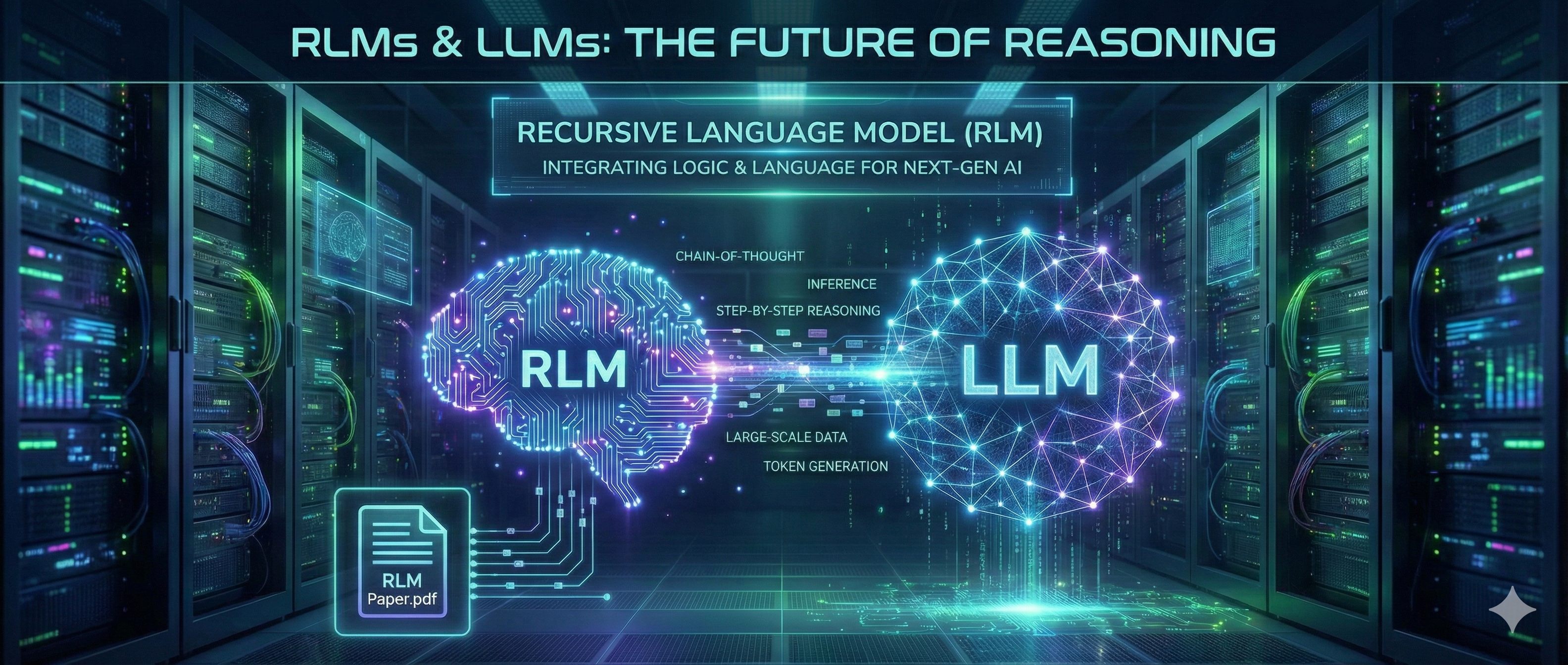
The core RLM approach from MIT CSAIL
The foundational RLM paper (arXiv:2512.24601, Zhang, Kraska, and Khattab) introduces two key design choices that distinguish it from prior work. First, the long prompt is stored as a Python variable in a REPL environment rather than passed directly to the model—the LLM receives only metadata about the variable (length, type) and writes code to inspect, slice, and process it programmatically. Second, the REPL enables recursive sub-calls via \llm_query()\ and \llm_batch()\ functions, allowing the model to spawn sub-LLMs on relevant snippets it identifies through code execution.
This architecture produces emergent behaviors not explicitly programmed: models spontaneously develop regex filtering based on priors, recursive chunking strategies, answer verification through sub-calls before committing, and output stitching from hundreds of invocations. On the LoCoDiff benchmark for code repository understanding, RLM achieves 62% accuracy versus 24% for baseline GPT-5, while handling inputs of 10M+ tokens that would be impossible for standard approaches.
The open-source implementation is available at github.com/alexzhang13/rlm, and Prime Intellect is actively productizing the approach with plans for configurable recursion depth, custom functions, and compression across conversation turns. The research team acknowledges current limitations: recursion depth is capped at one level in evaluation, the Jupyter environment is non-isolated (malformed code can crash sessions), and token overhead exists for simple tasks.
Commercial AI labs implement related but distinct architectures
Anthropic's Claude Code subagent system provides the closest commercial implementation to academic RLM patterns. The Task tool spawns subagents with isolated context windows, custom models, and restricted tool access. These subagents can be specialized (Plan subagent for research, Explore subagent for read-only search) or custom-defined via markdown files. A critical design constraint prevents subagents from spawning additional subagents, avoiding uncontrolled recursion. Cal Rueb from Anthropic's engineering team notes the primary benefit: "whenever Claude needs to do a bunch of research—figure out where a bug is—it will do it in the subagent. The subagent will read all the files and then report back its final findings to the main agent, and now the main agent has protected its context window." OpenAI's Deep Research, launched in January 2025 and available via API since June 2025, implements multi-step decomposition with tool calls but does not treat prompts as external environment variables—context is processed in extended attention. The system executes 80-160 search queries per research task, taking 5-30+ minutes for complex investigations. Google's Agent Development Kit (ADK) supports hierarchical multi-agent delegation via AgentTool, with \transfer_to_agent\ function calls enabling recursive task breakdown. Microsoft's Copilot Studio (public preview since Build 2025) implements multi-agent orchestration with cross-platform handoffs between M365 agents, Azure AI agents, and Fabric agents.
The gap between academic RLM and commercial implementations centers on one key architectural difference: no commercial system fully treats prompts as REPL environment variables. Commercial providers favor extended context windows (1-2M tokens) plus orchestration over true context offloading. However, the trajectory suggests convergence—Google's NotebookLM roadmap for 2026 includes a shift from "Passive Assistant" to "Active Agent" with deeper recursive capabilities.
Open-source frameworks have matured rapidly
The open-source ecosystem now offers production-ready recursive agent capabilities across multiple frameworks. LangGraph (21,000 GitHub stars) has emerged as the recommended choice for new agent implementations, with native support for self-RAG patterns, self-correcting agents, and cyclic workflows. Its graph-based state machine architecture naturally supports recursive calls, and it powers production deployments at Klarna, Replit, Elastic, and LinkedIn. CrewAI (30,500 stars, 1M monthly downloads) implements role-based multi-agent orchestration with hierarchical process management, where manager agents allocate and evaluate tasks across specialized crews. PwC reports improving code generation accuracy from 10% to 70% using CrewAI for enterprise automation. DSPy (31,300 stars) from Stanford NLP takes a programmatic approach, using MIPROv2 optimization to bootstrap demonstrations recursively and tune prompts based on defined success metrics—enabling a Llama-3.2-1B model to achieve 0.69 Pass@1 on constrained generation tasks compared to GPT-4o's 0.80. Mem0 (45,000 stars, $24M Series A in October 2025) addresses a complementary problem: persistent memory across sessions rather than within single long trajectories. Its hybrid database approach combining vector, key-value, and graph storage achieves 26% improvement over OpenAI memory on the LOCOMO benchmark with 91% lower p95 latency. Mem0 is now integrated as the exclusive memory provider for AWS Agent SDK and works natively with CrewAI, LangGraph, and AutoGen.Microsoft's unification of Semantic Kernel and AutoGen into the Agent Framework (public preview, GA targeted Q1 2026) brings enterprise-grade multi-agent orchestration with sequential, concurrent, group chat, and handoff patterns. OpenHands (formerly OpenDevin, 65,000 stars) provides full software development lifecycle automation with Docker/Kubernetes isolation for secure execution.
Startups have built massive valuations on recursive patterns
Cognition Labs' Devin exemplifies the RLM-adjacent approach at scale: an autonomous coding agent operating in a sandboxed compute environment with shell, code editor, and browser access. Cognition describes multi-agent capability where "one AI agent dispatches tasks to other AI agents"—a direct implementation of recursive patterns. After acquiring Windsurf for approximately $250M in July 2025 (following a dramatic bidding war that saw Google's $2.4B reverse-acquihire of Windsurf founders and OpenAI's $3B offer expire), Cognition now operates at $10.2 billion valuation with customers including Goldman Sachs, Santander, and Nubank. Cursor (Anysphere) reached $9.9 billion valuation and $500M+ ARR by implementing multi-agent orchestration in its AI-first code editor. Cursor 2.0 introduced up to 8 parallel agents working in isolated Git worktrees, with specialized roles: Architect Agent → Planner Agent → Implementation Agents. The Rules system (project, user, team, agent-level) stores persistent instructions as environment context, matching the RLM paradigm of prompts-as-variables. Bloomberg reports Cursor is used by "over half of Fortune 500" companies. Magic.dev ($465M raised, about $1.5B valuation) is betting on ultra-long context as the path to agentic AI, developing LTM (Long-Term Memory) networks enabling 100M token context windows with 1000x cheaper attention than Llama 405B for long contexts. Their inference-time compute focus—"the next frontier" according to CEO Eric Steinberger—aligns with RLM's emphasis on dynamic reasoning over pre-training. Imbue ($220M raised, $1B+ valuation) is building 100B+ parameter models specifically optimized for reasoning, with their Sculptor product implementing sandbox code execution and iterative verification. The browser automation space applies similar patterns to web interaction: MultiOn's Agent Q provides self-healing browser agents with multi-step task execution, while Induced AI (backed by Sam Altman) translates natural language to pseudo-code for workflow automation. The consolidation wave—Cognition acquiring Windsurf, Amazon hiring Adept leadership and licensing their technology, Google reverse-acquihiring Windsurf founders—signals that recursive agent capabilities have become strategic assets commanding premium valuations.Academic research explores sophisticated variations
The RLM paper explicitly references and differentiates from several related academic approaches. Context Folding (Sun et al., October 2025) introduces branch/return primitives with reinforcement learning-trained folding, achieving 62% on BrowseComp-Plus with only a 32K token budget—but folding boundaries remain scaffold-determined rather than emerging from model behavior. THREAD (Schroeder et al., NAACL 2025) frames generation as executable threads that spawn children dynamically, achieving state-of-the-art on ALFWorld and TextCraft but unable to handle inputs beyond base LLM context windows. ReDel (Zhu et al., EMNLP 2024) from Penn provides an open-source toolkit for recursive multi-agent systems where models decide when and how to delegate—available via PyPI and actively used in research. DisCIPL (Grand et al., MIT CSAIL) implements leader-follower orchestration where large "boss" models steer smaller "follower" models via probabilistic programming, enabling smaller models to approach precision of top reasoning systems. ViperGPT (Columbia, ICCV 2023) established an early pattern of code-generated tool composition for visual reasoning that influenced RLM's REPL approach. MemWalker (Princeton/Meta, 2023) constructs summary trees for interactive navigation, while ReSum (September 2025) enables indefinite exploration through periodic context summarization. AgentFold (Alibaba, October 2025) treats context as a dynamic cognitive workspace with multi-scale folding achieving 92% token reduction versus ReAct baselines. G-Memory (NeurIPS 2025) addresses multi-agent memory through a three-tier graph structure: Insight Graph for high-level knowledge, Query Graph for meta-information, and Interaction Graph for fine-grained communication logs. This hierarchical approach improves embodied action success rates by up to 20.89% across five benchmarks.Industry adoption trends point toward convergence
The emerging pattern across commercial, open-source, and startup implementations reveals several consistent trends. First, multi-agent orchestration has become the standard architecture for complex task handling—every major framework now supports hierarchical, recursive agent calling in some form. Second, memory management is being treated as infrastructure, with Mem0's $24M funding validating dedicated memory layers that integrate with any agent framework. Third, MCP (Model Context Protocol) and A2A (Agent-to-Agent) protocols are creating standardization that will enable more sophisticated recursive patterns across provider boundaries.The key capabilities that distinguish implementations closest to academic RLM:
- Context as environment variable: Cursor's Rules system, Cognition's sandboxed compute, Claude Code's subagent isolation
- REPL/code execution: Present in all major implementations (terminal access, code interpreter, sandbox execution)
- Recursive self-calls: Claude Code subagents, Cursor's parallel agents, Cognition's multi-agent dispatch, Google ADK's AgentTool
- Parallel sub-call execution: CrewAI's async tasks, Cursor's 8-agent parallelism, Claude Code's concurrent subagents
Conclusion: The paradigm shift is underway but incomplete
Recursive Language Models represent a genuine architectural innovation: by treating prompts as external environment variables accessible through code execution, they enable handling of inputs 100x beyond context windows while improving performance and reducing costs. The RLM paper's demonstration that GPT-5-mini with this approach doubles GPT-5's performance on long-context benchmarks challenges the assumption that larger context windows require architectural scaling.
Commercial implementations remain partial—Claude Code subagents and Cursor's multi-agent system come closest to the full RLM specification, but no production system fully treats prompts as REPL environment variables. The startup ecosystem has validated recursive patterns at massive scale, with Cognition and Cursor commanding combined valuations exceeding $20 billion. Open-source frameworks provide immediate access to hierarchical orchestration, with LangGraph, CrewAI, and DSPy offering production-ready capabilities.
Prime Intellect's characterization of RLM as "the paradigm of 2026" may prove prescient. The combination of demonstrated performance gains, active productization, and convergent architectural choices across the industry suggests that full RLM-style implementations—where models autonomously write code to examine, chunk, and recursively process arbitrarily long inputs—are a near-term development rather than distant research goal.