
Solar Year Clock: A Year of Daylight on One Dial
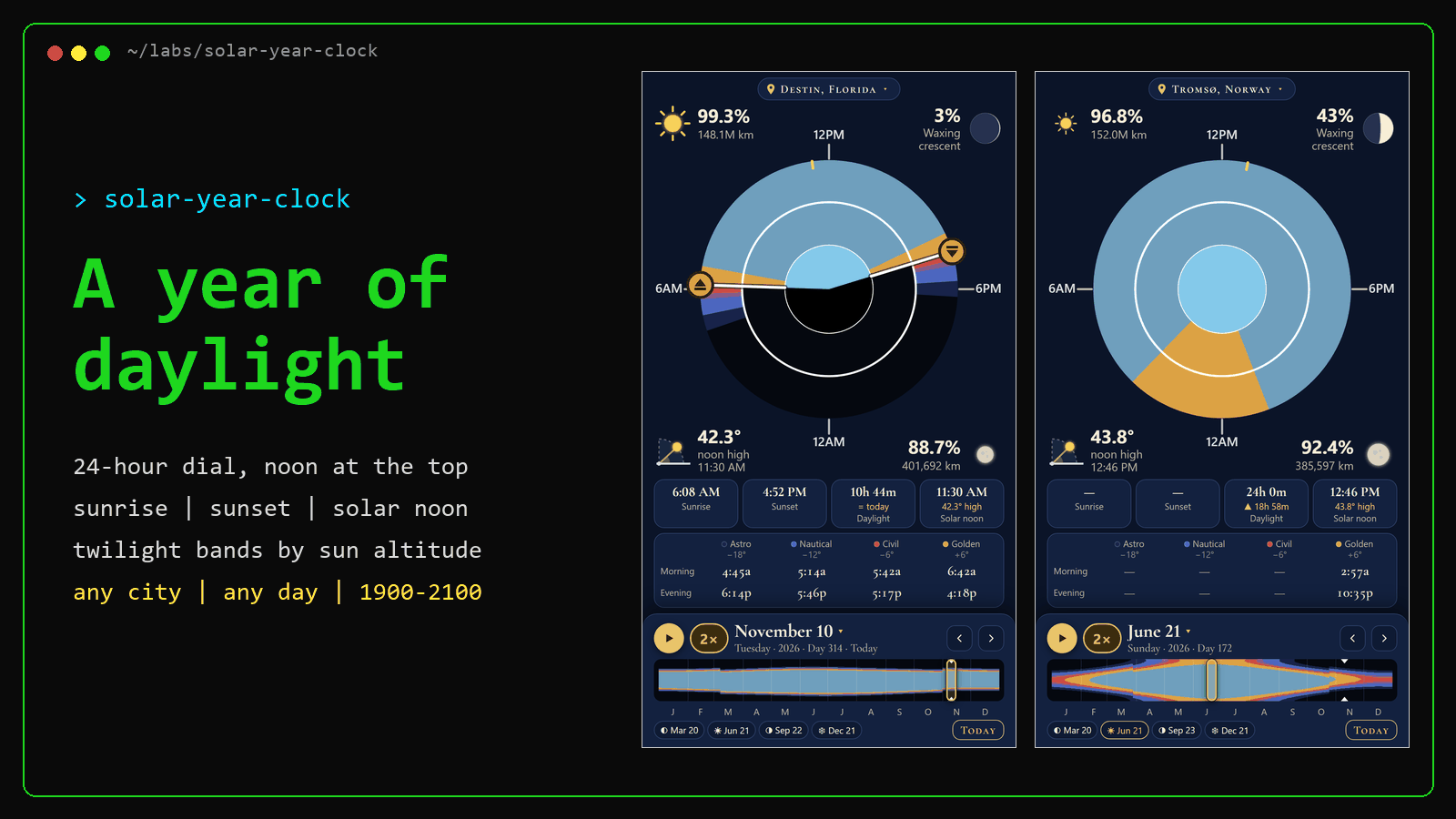
Pick a place and a day. Solar Year Clock draws that day as a 24-hour dial: when the sun rises and sets, how long each stage of twilight lasts, and how high the sun gets at noon. Drag the slider and the dial moves through the year. It runs right here in the page; everything below explains what you're looking at.
Try it
Open Solar Year Clock full screen →
Drag the strip at the bottom, or press play to run the whole year. Tap the city name to change location. The full-screen version keeps your place and date in its address, so you can bookmark or share a link to an exact day. It works on phones.
01 · What this tool does
A sunrise table gives you two times per day. That hides most of what is interesting: how fast the days are changing, how long dusk lasts, and how different all of this is at another latitude. The clock shows three things together:
- One day, as a dial with every stage of light and dark on it.
- The whole year, as a strip under the dial, so you can see where that day sits.
- The numbers: sunrise, sunset, daylight length, solar noon, twilight times, and the sun's and moon's distance.
It opens on Destin, Florida, today. Everything is calculated in your browser.
02 · The dial
The dial is a 24-hour clock face. Noon is at the top and midnight is at the bottom. Time runs clockwise, so 6 AM is on the left and 6 PM is on the right. The top half is roughly the day and the bottom half is roughly the night, which is why a winter day looks like a shallow cap of blue and a summer day wraps well past the 6 AM and 6 PM marks.
- Outer ring: the full detail. Seven colour bands, from daytime through each stage of twilight to night (section 03).
- Middle ring: a simpler view of the same day. Daytime, golden hour, and everything after sunset as one dark band.
- Centre disc: a light-blue wedge from sunrise to sunset on black. This is the quickest read of "how much of the day is daylight."
- White spokes with gold markers: sunrise (arrow up) and sunset (arrow down).
- Yellow notch on the rim: solar noon, when the sun is highest.
Solar noon is rarely at 12:00. In Destin on November 10, 2026 it is at 11:30 AM. Two things cause that. Destin is east of the centre of its time zone, so the sun crosses about 14 minutes early. And in early November the sun runs about 16 minutes ahead of clock time (the "equation of time"). In summer, daylight saving time pushes solar noon the other way, to around 12:48 PM.
03 · The colour bands
Each band is set by one thing: how many degrees the sun is above or below the horizon. Civil, nautical and astronomical twilight are standard definitions. Golden hour and blue hour are photographers' terms with no official limits; the clock uses the common ones below.
| Band | Sun's altitude | What it looks like |
|---|---|---|
| Daytime | above +6° | Full daylight |
| Golden hour | +6° down to the horizon | Low, warm light and long shadows |
| Civil twilight | horizon to −4° | Sun is down, sky still bright |
| Blue hour | −4° to −6° | Deep blue sky; the end of civil twilight |
| Nautical twilight | −6° to −12° | Horizon still visible at sea, bright stars out |
| Astronomical twilight | −12° to −18° | Looks like night; a faint glow remains |
| Night | below −18° | Fully dark sky |
"The horizon" here means −0.833°, the standard figure for sunrise and sunset. It is the moment the top edge of the sun touches a flat horizon, allowing for the air bending the light.
The twilight grid under the dial gives the clock times for these lines: when the sun crosses −18°, −12°, −6° and +6°, morning and evening. A dash means the sun doesn't cross that line that day.
04 · The year strip
The strip at the bottom is the whole year in one picture. Each column is one day, January on the left. Top to bottom is the 24 hours of that day, with noon in the middle. The colours are the same seven bands. The gold handle is the day on the dial, and the small white triangles mark today.
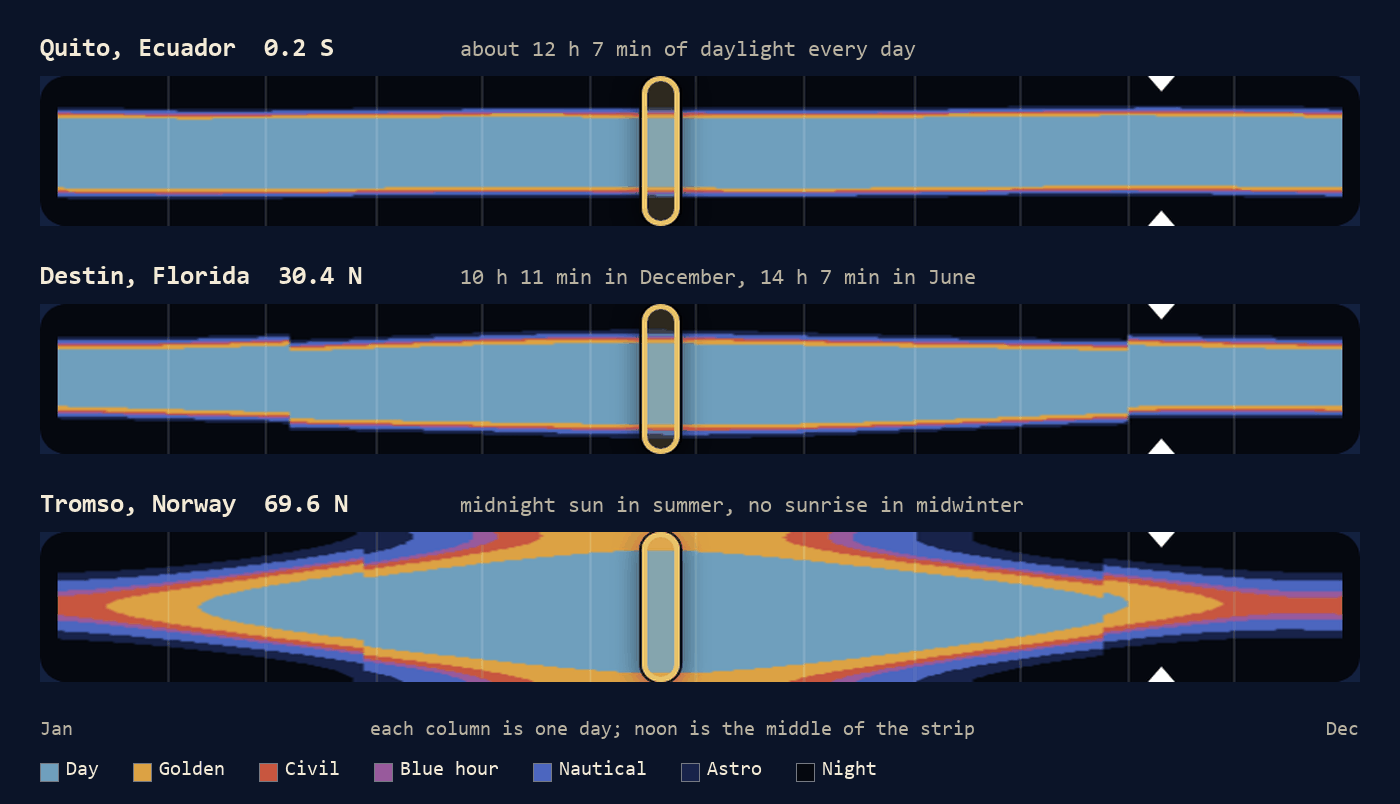
The same strip at three latitudes. Quito, on the equator, barely changes. Destin swings about four hours between winter and summer. Tromsø, inside the Arctic Circle, has weeks with no sunset and weeks with no sunrise.
Three things to notice:
- The shape is the latitude. Near the equator the strip is a flat bar: Quito gets about 12 hours 7 minutes every day of the year. In Destin the bar bulges in summer: 10 hours 11 minutes of daylight on December 21, 14 hours 7 minutes on June 21. In Tromsø it opens into an eye, with the midnight sun in the middle and no sunrise at all in midwinter.
- The steps are daylight saving time. Where the clocks change, the whole pattern jumps by an hour. Quito has no step because Ecuador doesn't change its clocks.
- Twilight gets longer away from the equator. The coloured edges are thin lines in Quito and wide bands in Tromsø, because the sun sets at a shallow angle there.
The four buttons under the strip jump to the equinoxes and solstices. Press play to run the year: at 2× a year takes 7 seconds.
05 · The numbers
Four tiles sit under the dial:
- Sunrise and Sunset, in the local time of the place you picked, not your own.
- Daylight: sunrise to sunset. The small line under it compares that day with today, for example "▲ 3h 23m" for a day that is 3 hours 23 minutes longer.
- Solar noon: when the sun is highest, and how high it gets.
Four badges sit in the corners of the dial:
- Sun closeness (top left). 100% is Earth's closest point to the sun, 147.1 million km; the farthest point reads about 96.7%. Earth is closest in early January, so northern winters are not caused by distance. The seasons come from the tilt, which is what the noon height shows.
- Moon phase (top right): how much of the moon is lit, and the phase name. The picture flips in the southern hemisphere, where the moon appears the other way up.
- Noon height (bottom left): the sun's angle above the horizon at solar noon. 0° is the horizon and 90° is straight overhead. Destin gets 36.2° on December 21 and 83.0° on June 21.
- Moon closeness (bottom right). 100% is the moon's closest possible approach, 356,400 km; at its farthest, 406,700 km, it reads about 87.6%.
The sun and moon icons grow and shrink with distance, but the change is exaggerated so you can see it. In the real sky the sun's size changes by only about 3.4% over the year.
06 · Location and controls
Tap the city name at the top to change location. You can:
- Search for a city. The list has 135,233 places with 1,000 or more people, from GeoNames. "Paris", "Springfield, IL" and "paris france" all work. The list is a 5 MB file that loads the first time you open the picker, and the search runs on your device.
- Use your current location. Your browser asks first. The coordinates are used in the page and are not sent anywhere.
- Enter a latitude and longitude. The nearest listed place supplies the time zone.
Every place carries its own time zone, so times are local to that place, including daylight saving changes.
| Control | What it does |
|---|---|
| Drag the year strip | Move through the year |
| Play, and the speed button | Run the year in 28, 14, 7 or 3.5 seconds |
| Tap the date | Pick any date from 1900 to 2100 |
| ‹ and › | One day back or forward; hold to repeat |
| Today | Return to today |
Space | Play or pause |
← → | One day; with Shift, one week |
T / L | Today / change location |
07 · How it works, and limits
The sun's position comes from the algorithm behind NOAA's Solar Calculator. For each day the clock works out the sun's altitude every 4 minutes and finds where it crosses each line. NOAA says its method is accurate to within a minute for sunrise and sunset between 72° north and south, and within 10 minutes closer to the poles. Equinox and solstice dates use Jean Meeus's formulas.
What it does not know about:
- Your actual horizon. It assumes a flat horizon at sea level. Hills, buildings and trees make the sun appear later and vanish earlier. Standing higher up does the opposite.
- The weather. Unusual air conditions near the horizon can move sunrise and sunset by a minute or more, and clouds decide how the light looks. Golden hour on the dial is a sun angle, not a promise.
- Moon detail. Moon figures use a simplified formula and are a snapshot at local noon on the chosen day. Moonrise and moonset are not shown.
- Time zone history. Time zones and daylight saving rules come from your browser. For dates decades back or ahead they are whatever your browser has on record.
- Years outside 1900 to 2100.
Use it for planning and for understanding the pattern. For navigation, or anything where a minute matters, use an official almanac.
Sources
- NOAA Global Monitoring Laboratory: Solar Calculator
- NOAA: Solar Calculation Details (method and stated accuracy)
- National Weather Service: definitions of civil, nautical and astronomical twilight
- Jean Meeus, Astronomical Algorithms, 2nd ed. (Willmann-Bell, 1998): equinox and solstice formulas
- GeoNames: city names, coordinates and time zones (CC BY 4.0)